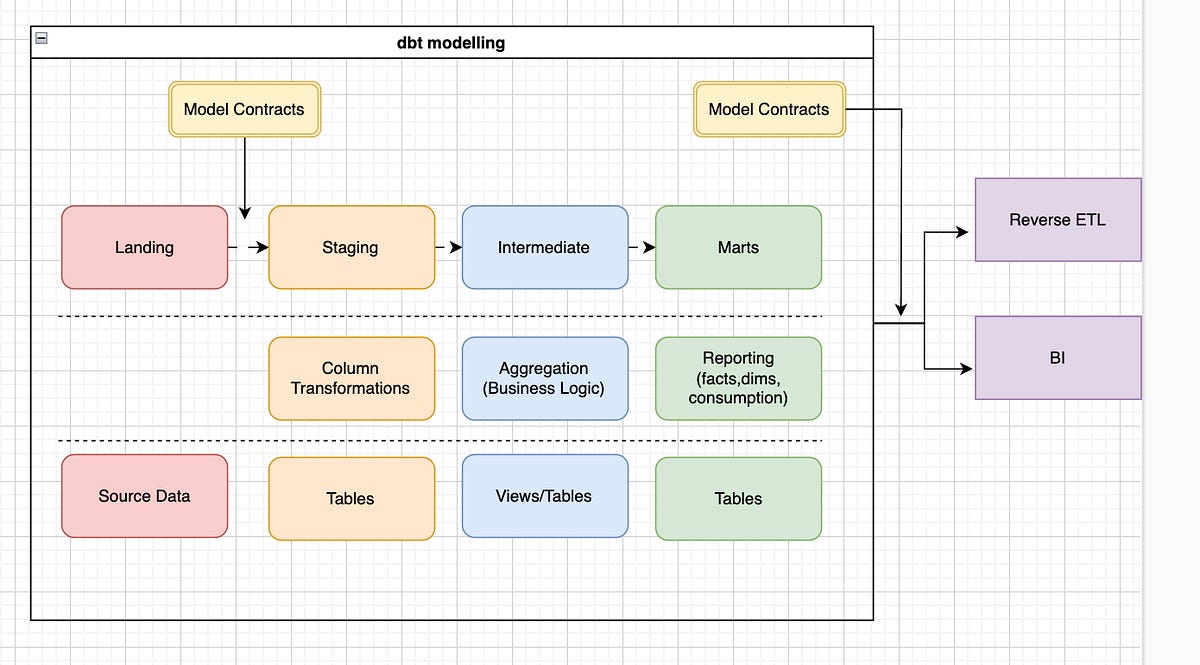
dbt (data build tool) is a powerful tool for transforming raw data into meaningful insights. It organizes data transformation into distinct layers, each serving a specific purpose. This structured approach ensures data is clean, consistent, and ready for analysis. Below, we delve into each layer in detail.
Landing Layer
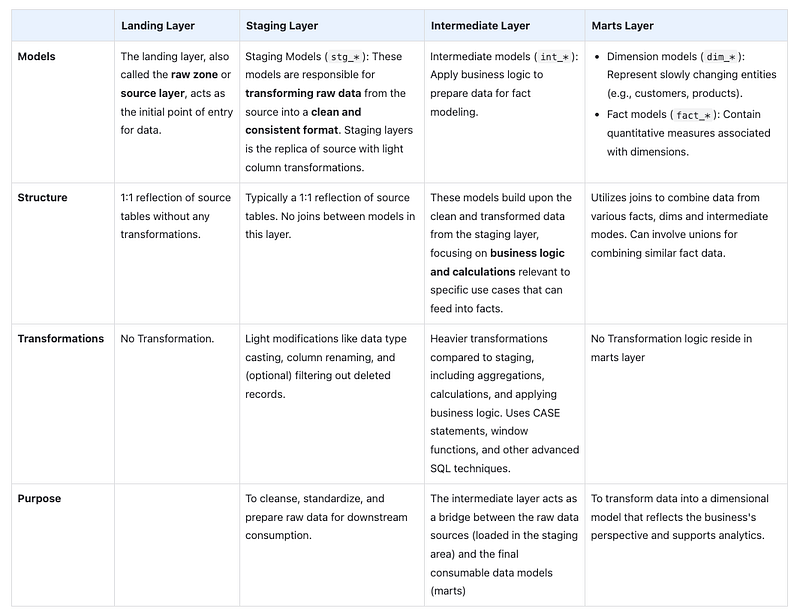
**Models —**The landing layer, also called the raw zone or source layer, acts as the initial point of entry for data.
**Structure —**1:1 reflection of source tables without any transformations.
**Transformations —**No Transformation.
Staging Layer
**Models —**Staging Models (stg_*): These models are responsible for transforming raw data from the source into a clean and consistent format. Staging layers is the replica of source with light column transformations.
**Structure —**Typically a 1:1 reflection of source tables. No joins between models in this layer.
**Transformations —**Light modifications like data type casting, column renaming, and (optional) filtering out deleted records.
**Purpose —**To cleanse, standardize, and prepare raw data for downstream consumption.
Intermediate Layer
**Models —**Intermediate models (int_*): Apply business logic to prepare data for fact modeling.
**Structure —**These models build upon the clean and transformed data from the staging layer, focusing on business logic and calculations relevant to specific use cases that can feed into facts.
**Transformations —**Heavier transformations compared to staging, including aggregations, calculations, and applying business logic. Uses CASE statements, window functions, and other advanced SQL techniques.
**Purpose —**The intermediate layer acts as a bridge between the raw data sources (loaded in the staging area) and the final consumable data models (marts)
Marts Layer
Models
- Dimension models (
dim_*): Represent slowly changing entities (e.g., customers, products). - Fact models (
fact_*): Contain quantitative measures associated with dimensions.
**Structure —**Utilizes joins to combine data from various facts, dims and intermediate modes. Can involve unions for combining similar fact data.
**Transformations —**No Transformation logic reside in marts layer
**Purpose —**To transform data into a dimensional model that reflects the business’s perspective and supports analytics.
Model Contracts
For model contracts refer to the below article
https://medium.com/@emp0-data-whisperer/dbt-model-contracts-e0a6a6e58c0e
This article was originally published at https://medium.com/@aradsouza/understanding-dbt-modelling-layers-and-their-purpose-ff393e96d83a