Using AI-powered problem framing and sprint-goal generation to align agile teams around outcomes instead of task lists.
Agent skill GitHub Repo link in references.
Most sprint failures are not caused by poor execution.
They happen because teams begin implementation before alignment exists.
A vague requirement enters backlog refinement, gets converted into stories too quickly, and turns into sprint commitments that optimise delivery activity instead of business outcomes. The result is predictable: teams complete tickets but still miss the actual objective.
This is where the sprint-goal-writer and problem-framing Agent Skills become valuable.
Rather than treating sprint planning as a story aggregation exercise, these skills introduce structured problem definition and outcome-driven sprint goals directly into the developer workflow.
The goal is simple:
Define the right problem before delivery starts, then ensure the sprint has a measurable outcome once work is committed.
Why Most Sprint Goals Fail
Many sprint goals are simply renamed task lists.
Examples like:
“Complete payment integration and finish notification service.”
do not provide:
- direction,
- prioritisation guidance,
- or meaningful trade-off leverage during the sprint.
When blockers appear or scope changes, these goals collapse because they describe activities, not outcomes.
A strong sprint goal should answer:
“What meaningful change will exist for the customer or business at the end of this sprint?”
That distinction changes how teams plan, prioritise, and make delivery decisions.
The sprint-goal-writer Agent Skill
The sprint-goal-writer skill converts committed sprint stories into a concise, outcome-oriented sprint objective aligned with Scrum principles.
Instead of summarising tickets, it synthesises:
- business intent,
- user impact,
- and delivery scope
into a single operational goal.
Example transformation:
Weak Sprint Goal
Complete authentication refactor and implement notifications.
Strong Sprint Goal
Enable customers to receive real-time transaction updates after completing purchases, reducing support dependency through improved visibility.
The second version provides the following:
- a user outcome,
- a measurable direction,
- and a decision-making framework for the sprint team.
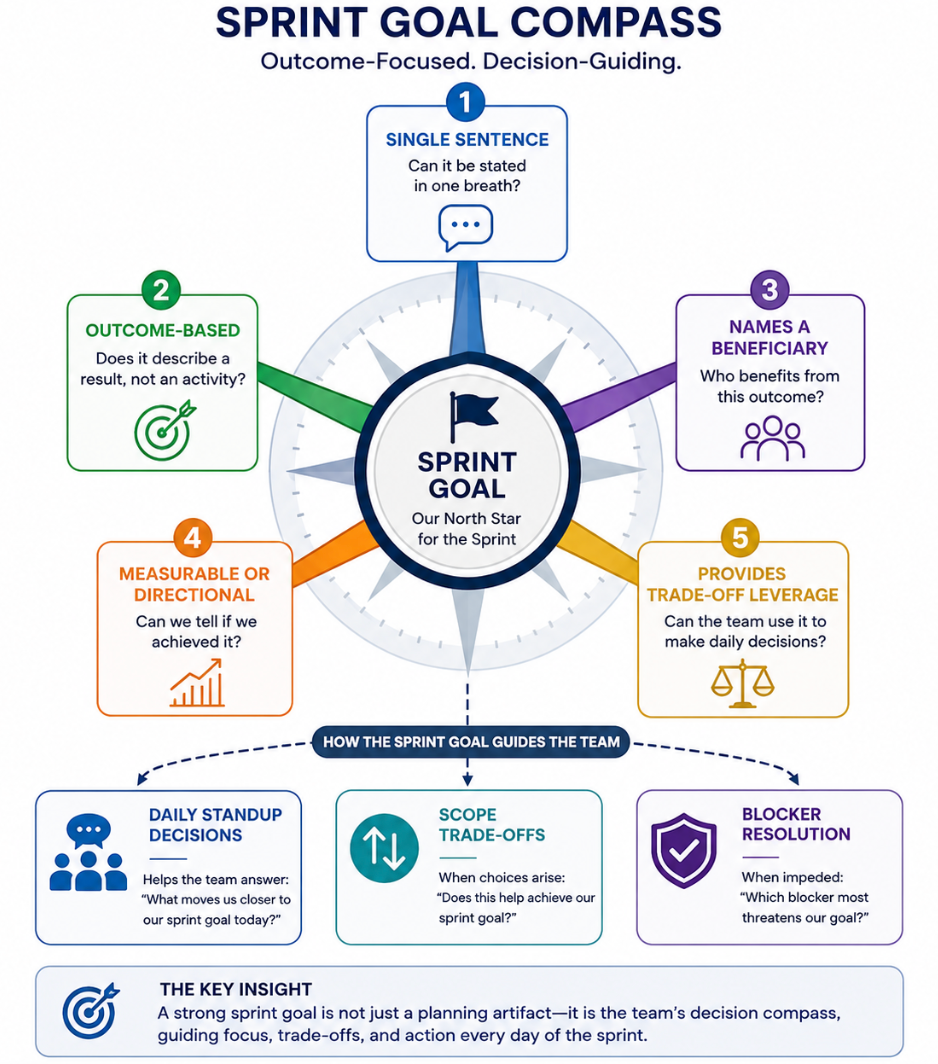
The Five-Point Sprint Goal Validation Model
Every generated sprint goal is evaluated against five validation checks.
1. Single Sentence
The goal should be concise enough to communicate clearly during standups and sprint reviews.
2. Outcome-Oriented
It must describe a result, not implementation tasks.
3. Beneficiary-Focused
The goal should clearly identify who benefits from the outcome.
4. Measurable or Directional
Teams should be able to determine whether the goal was achieved.
5. Trade-Off Enabling
The goal should help teams decide what matters most when priorities shift mid-sprint.
This transforms sprint goals from planning artefacts into operational alignment tools.
Problem Framing Before Sprint Planning
The sprint goal skill works best when paired with the problem-framing Agent Skill.
This skill implements the MITRE Problem Framing Canvas — a structured framework used to refine vague requests into actionable problem definitions before stories are written.
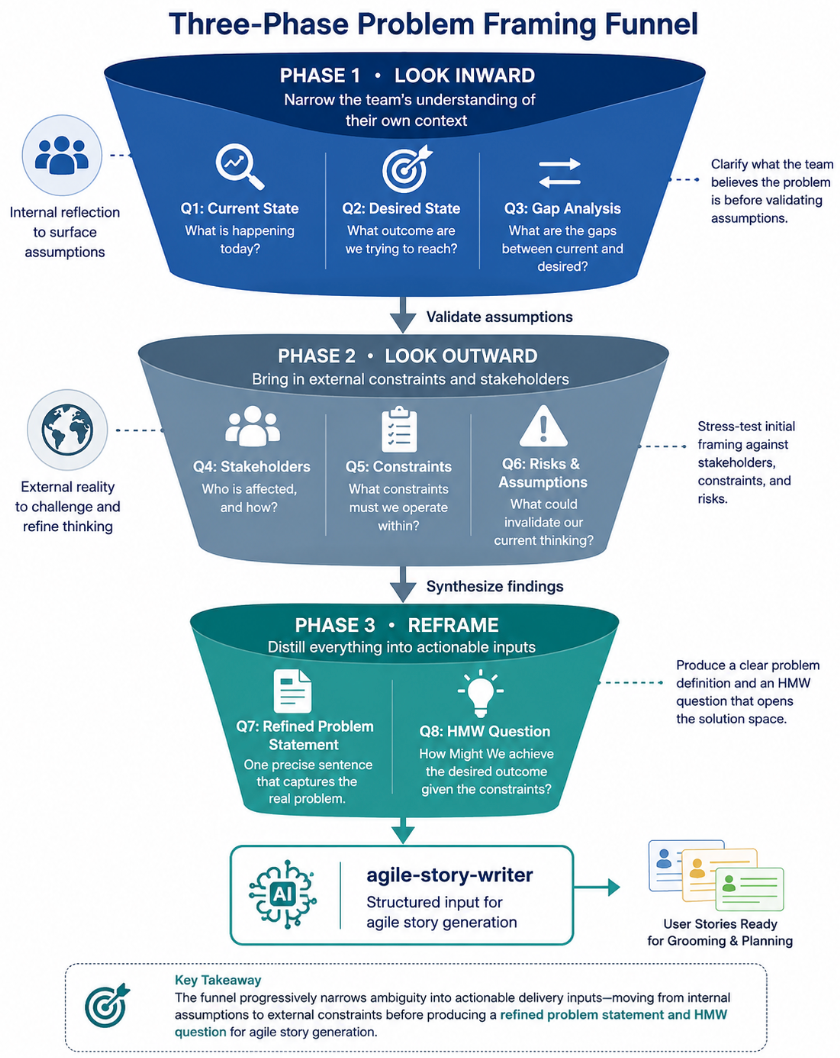
The framework moves through three stages:
Phase 1 — Look Inward
- Current state
- Desired state
- Gap analysis
Phase 2 — Look Outward
- Stakeholders
- Constraints
- Risks and assumptions
Phase 3 — Reframe
- Refined problem statement
- “How Might We” (HMW) question
The HMW question becomes the bridge between business intent and implementation planning.
Instead of asking:
“How do we build feature X?”
teams begin asking:
“How might we improve customer onboarding while reducing support dependency and maintaining compliance constraints?”
That shift dramatically improves backlog quality before engineering effort begins.
The End-to-End Workflow
The complete workflow becomes:
1. Problem Framing
Convert vague business requests into refined problem statements and HMW questions.
2. Story Generation
Generate structured agile stories aligned with the framed problem.
3. Story Splitting
Automatically decompose oversized stories into vertically sliced deliverables.
4. Sprint Goal Definition
Generate a measurable sprint outcome aligned with customer or business impact.
This creates a delivery pipeline focused on:
- alignment,
- clarity,
- and measurable outcomes.
Not just ticket throughput.
Practical Use Cases
During Sprint Planning
Paste committed stories into /sprint-goal-writer to generate an outcome-focused sprint goal.
During Retrospectives
Run historical sprint goals through the validation model to identify weak planning patterns.
During Discovery
Use /problem-framing before backlog refinement to reduce ambiguity and improve stakeholder alignment.
During Scope Trade-Offs
Use the sprint goal as the prioritisation anchor when blockers or scope changes occur.
Why This Matters
High-performing agile teams are not defined by velocity alone.
They are defined by:
- clarity of intent,
- shared understanding,
- and disciplined decision-making.
Agent Skills like problem-framing and sprint-goal-writer do more than automate documentation.
They encode delivery discipline directly into the engineering workflow.
The result is:
- better sprint alignment,
- fewer misinterpreted requirements,
- stronger backlog quality,
- and more outcome-driven delivery cycles.
GitHub Repository
Agile Story Skills Repository
agile-story-skills GitHub Repository
The repository includes:
- problem-framing
- sprint-goal-writer
- agile-story-writer
- agile-story-splitter
along with structured prompts, workflow patterns, and implementation examples for AI-augmented agile delivery.
References
Alwyn D’Souza is working at the intersection of data mesh architectures, MLOps, and agentic AI systems. He writes about modern data engineering and practical AI implementations on Medium at @aradsouza, shares open-source tools at github.com/alwyndsouza, and connects with the professional community on LinkedIn.
This article was originally published at https://aradsouza.medium.com/defining-better-sprint-goals-with-github-copilot-agent-skills-6c2448d8a4b7?source=rss-670f6306e3c0------2