Choosing Your Historical Data Strategy: Comparing dbt Snapshots and CDC-Driven Custom SCD2
Slowly Changing Dimensions (SCD Type 2) are foundational for tracking historical data in analytics and compliance. In modern data stacks, two dominant approaches emerge: dbt Snapshots and Custom SCD2 logic (especially enhanced with Change Data Capture, or CDC). Each serves different needs, and understanding their differences is critical for making the right choice in data engineering.
What Are dbt Snapshots?
dbt Snapshots are a declarative configuration within dbt that automatically version row-level changes in a source table over time. When a change is detected during each dbt run, Snapshots create new entries, managing validity intervals (via dbt_valid_from and dbt_valid_to) and maintaining a “history” without custom CDC logic or extensive SQL development.
- Architecture: Select query + YAML snapshot configuration.
- Automation: dbt manages inserts/updates, tracks changes, and versioning in snapshot tables.
- Efficiency: Best suited for analytical, batch workloads where near real-time tracking isn’t required.
What Is Custom SCD2 Logic (with CDC)?
Custom SCD2 Logic involves manually written SQL models that implement Type 2 behavior — new rows for each change, explicit “valid from/to” columns, versioning logic, and, often, CDC integrations for higher granularity and timeliness.
- CDC Integration: CDC tracks each source change in real time (or near-real time), often parsing database logs, triggers, or streams to collect every data change and send those as events to downstream systems.
- Flexibility: Engineers can design bespoke change detection, apply custom business rules, and extend beyond Type 2 for advanced audit/compliance requirements.
- Complexity and Cost: Requires orchestration, monitoring, development, and additional infrastructure.
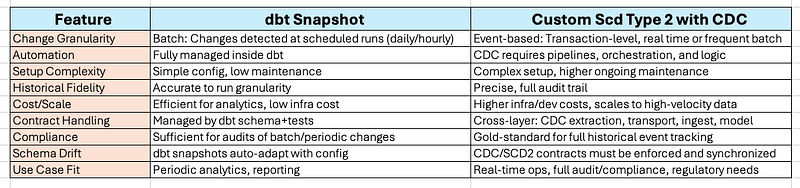
Technical and Functional Comparison
When Best to Use Snapshot and Custom SCD Type 2 Logic
dbt Snapshot Works Best When:
- Historical analysis is performed in scheduled batches
- Data changes infrequently
- Simplicity, speed to implementation, and low operational overhead are prioritized
- Example: Monthly reporting on customer tier, annual compliance audits
Custom SCD2 with CDC Is Better When:
- High change velocity, frequent data mutability
- Regulatory environments requiring full transactional history and precise audit trails
- Operational dashboards and real-time systems powering product features
- Schema must be strictly validated at every layer
- Example: Financial transactions, healthcare records, fraud detection analytics
Final Thoughts
dbt Snapshots and Custom SCD2 with CDC both enable SCD2, but their design philosophies differ:
- dbt Snapshots are ideal for analytical, batch-driven, lower-complexity environments with moderate history needs.
- Custom SCD2 with CDC deliver best-in-class historical fidelity, real-time data, and strict contract enforcement for high-compliance and operational workloads.
Choosing between them depends on the organization’s requirements for change granularity, cost, compliance, and engineering investment. Carefully consider your business needs — and the full data contract lifecycle — before architecting your solution.
References
[**Add snapshots to your DAG | dbt Developer Hub**
*Configure snapshots in dbt to track changes to your data over time.*docs.getdbt.com](https://docs.getdbt.com/docs/build/snapshots "https://docs.getdbt.com/docs/build/snapshots")[**Slowly Changing Dimensions (SCD): 4 Types & How to Implement**
*Slowly changing dimensions refer to how data in your data warehouse changes over time. As your data changes, it allows…*www.thoughtspot.com](https://www.thoughtspot.com/data-trends/data-modeling/slowly-changing-dimensions-in-data-warehouse "https://www.thoughtspot.com/data-trends/data-modeling/slowly-changing-dimensions-in-data-warehouse")[**A Practical Guide To Creating Slowly Changing Dimensions Type 2 In Dbt | Part 1 | Xebia**
*Many companies are using the Kimball dimensional modelling framework to model their data and will undoubtedly think of…*xebia.com](https://xebia.com/blog/a-practical-guide-to-creating-slowly-changing-dimensions-type-2-in-dbt-part-1/ "https://xebia.com/blog/a-practical-guide-to-creating-slowly-changing-dimensions-type-2-in-dbt-part-1/")
This article was originally published at https://medium.com/@aradsouza/dbt-snapshot-vs-custom-scd2-with-cdc-comparative-analysis-e34e48168973