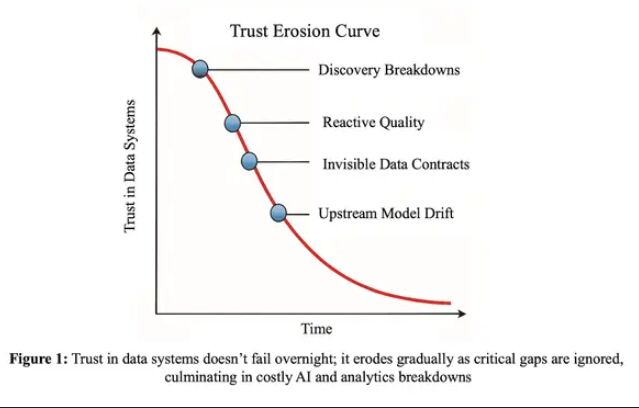
Ever feel like your AI projects are hitting a wall, even when the tech seems fine? Often, it’s not the AI itself, but the hidden “trust erosion” in your data that’s quietly derailing everything.
It’s about the vital data foundation beneath your shiny AI. The companies winning with AI aren’t the ones with perfect data. They’re the ones with resilient systems that catch imperfections early and respond by design.
Here are four signals your data trust is crumbling, and how to shore it up with practical steps and tools.
1. Data Discovery Breakdown 🕵️♀️
Your team spends more time playing data detective than actually using data. Finding the right, trustworthy dataset feels like a treasure hunt without a map. This inefficiency kills trust and innovation.
The Fix: Invest in metadata management and data catalogs. These tools create a searchable inventory of all your data assets, including information about what the data is, where it comes from, and who owns it. This empowers your teams to quickly find and understand the data they need, replacing guesswork with confidence.
Tools to Explore:
- Collibra: A comprehensive data governance platform that helps you manage, govern, and trust your data by providing features for data classification, privacy, quality, and lineage.
- Alation: A data intelligence platform that combines data cataloging, data governance, and analytics enablement to help teams find, understand, and use data effectively.
- Atlan: A data democratization company that helps teams collaborate on data projects by creating a home for data teams to democratize both internal and external data while automating repetitive tasks.
2. Reactive Data Quality 🚨
You’re constantly putting out “data quality fires” after issues hit your customers or reports. A marketing campaign goes wrong, a dashboard breaks… the damage is done and trust is shaken. This reactive approach is inefficient and costly.
The Fix: Deploy automated data observability frameworks. These frameworks act like a health monitor for your data, continuously checking its freshness, volume, distribution, and consistency. By catching anomalies and other issues as they happen, you can be proactive, not just reactive, and fix problems before they impact your business.
Tools to Explore:
- Monte Carlo: A data observability platform that helps you prevent bad data from reaching customers by monitoring and alerting on data issues in real time.
- Soda: A data reliability and observability platform that helps data teams discover, prioritize, and resolve data quality issues.
- Acceldata: An enterprise data observability cloud that helps you monitor and manage the reliability, quality, and performance of data systems.
3. Invisible Data Contracts 🤝
Your data dependencies rely on unwritten rules and tribal knowledge between teams. When a new system rolls out or someone leaves, everything breaks because those “understood” agreements vanish. This lack of clear, explicit agreements leads to brittle data pipelines and frequent failures.
The Fix: Establish explicit, versioned data contracts. A data contract is a formal agreement between data producers and consumers that defines the schema, quality rules, and ownership of a dataset. By formalizing these agreements and embedding them directly into your data pipelines, you make dependencies visible and predictable.
Tools to Explore:
- Datafold: A data diff platform that helps teams prevent data quality issues by automatically comparing datasets and ensuring data contracts are being met.
- Pact: While Pact is more commonly known for consumer-driven contract testing in microservices, its principles can be applied to data contracts to ensure that data producers and consumers have a shared understanding of data structures.
- Great Expectations and dbt: These open-source tools can be paired with schema registries to formalize data definitions and quality rules, embedding them directly into your data pipelines for automated validation.
4. Upstream Model Drifts 🕰️
Your once-brilliant AI model that predicted churn perfectly suddenly starts making mistakes. Subtle, unmonitored changes in the input data have silently eroded its accuracy, wasting your AI investment. This phenomenon, known as data drift, is a silent killer of model performance.
The Fix: Give your AI a regular health check-up! Integrate model monitoring directly with your data observability. This allows you to track not only the performance of your AI models but also the health of the data they are trained on and using for predictions. By monitoring for data drift and other changes, you can retrain or update your models before their performance degrades.
Tools to Explore:
- Datadog and Grafana: These monitoring tools can be configured to track model performance metrics and alerts.
- MLflow: An open-source platform for managing the end-to-end machine learning lifecycle, including experiment tracking and model management.
- Arize AI and Fiddler AI: These are dedicated machine learning observability platforms that help you monitor, explain, and troubleshoot models in production, with a focus on detecting data drift and other performance issues.
If you’ve been struggling to get your AI initiatives off the ground or maintain their performance, it might be time to look beyond the model itself and rebuild trust in your data foundation. Investing in the right tools and practices will not only improve your AI’s accuracy but also foster a culture of data confidence across your entire organization.
References
This article was originally published at https://medium.com/@aradsouza/why-your-ai-projects-are-failing-and-its-not-the-ai-s-fault-1bc784d3d94f