In the age of AI, software security isn’t just about code — it’s about algorithms, data pipelines, and complex models. This shift demands a radical evolution from traditional DevSecOps to MLSecOps, which requires a uniquely skilled, cross-functional team. Building security into your AI ecosystem isn’t a job for one department; it’s a team sport.
Here’s how to build your MLSecOps Dream Team and foster the cross-collaboration necessary for success.
Building the Team: Ownership and Key Roles
MLSecOps, like any robust security strategy, relies on the pillars of people, process, and technology. The “people” component requires a roster specifically tailored to the nuances of Artificial Intelligence.
We can divide the key stakeholders into four essential groups:
- ML Practitioners: This group — including ML Engineers, Data Scientists, and ML Architects — owns the integrity and function of the AI assets. They are responsible for the design, development, maintenance, and reliability of the models and data pipelines.
- Security Experts: These team members (e.g., security architects, threat analysts) help the larger team understand threats specific to AI/ML, the associated risks, and recommended mitigations. They translate traditional cybersecurity principles into the ML context.
- Subject Matter Experts (SMEs): This group understands the business or industry context. Roles like UX Designers ensure that security measures don’t compromise the user experience, while other SMEs align security with overall organizational goals.
- Regulatory Experts: Team members from Legal, Compliance, and HR are crucial for navigating the complex landscape of regulations, compliance mandates, and ethical guidelines, safeguarding AI initiatives from legal or social pitfalls.
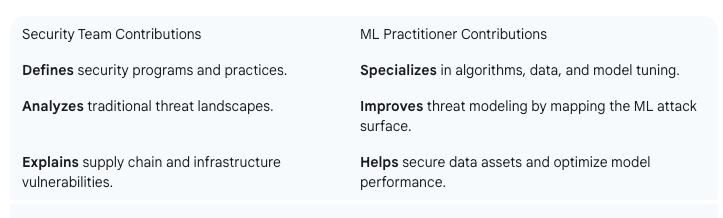
This diversity is vital because AI security requires bridging the knowledge gap between technical security and machine learning science. ML practitioners understand model intricacies but may miss traditional threat vectors, while security experts know vulnerabilities but might not grasp how a model’s core components are susceptible to attack. The Dream Team unites these essential, yet often separate, objectives.
The Violet Teaming Integrative Framework
If you’re familiar with the cyber security concept of Purple Teaming (combining offensive Red Team strategies with defensive Blue Team strategies), Violet Teaming is the evolution tailored for AI.
Introduced by Dr. Alexander Titus, Violet Teaming is an integrative framework that expands the collaboration beyond red and blue. It brings in viewpoints from a wider array of stakeholders to address risks related to impact, privacy, usability, and ethics.
Violet Teaming isn’t just about finding technical vulnerabilities; it’s a holistic strategy that focuses on “building security in” at every stage.
- Expanded Viewpoint: By converging expertise from ML engineers, security experts, privacy lawyers, and ethics experts, the team gains a complete perspective.
- Novel Risk Identification: A privacy lawyer, for example, might ask about the potential for de-anonymization or how a data lakehouse could reconstitute sensitive data, concerns that might not be top-of-mind for a security engineer focused on network intrusion.
- Ethical and Social Guardrails: This approach ensures the team considers non-technical risks like the social and ethical impacts of algorithmic bias, securing the system not just against hackers, but against unintended societal harm.
Adopting the violet teaming concept is a powerful tool for defining your organization’s needs and structuring your MLSecOps Dream Team.
Facilitating Cross-Collaboration for Implementation
The success of MLSecOps hinges on dissolving organizational silos. The foundational partnership is between Security and ML practitioners.
Collaboration in Practice
To operationalize this partnership, organizations need a culture of knowledge sharing:
- Joint Inventory and Scans: Security and ML teams must collaborate to create a full Machine Learning Bill of Materials (ML-BOM) and jointly conduct model security scans.
- Threat Modeling: Security professionals should integrate ML expertise into their threat modeling sessions to foresee attacks like model poisoning or evasion.
- Incident Response: ML practitioners benefit from a security team’s insights into data privacy, incident response protocols, and regulatory compliance.
Beyond Security and ML
Cross-collaboration must extend to other key stakeholders:
- Legal: Provides crucial insights into regulatory compliance (e.g., geographic data laws, consequences of algorithmic bias). They ensure all AI deployments mitigate legal risks.
- Human Resources (HR): Ensures personnel receive the necessary training to use AI/ML responsibly, helping employees understand ethical implications and data privacy best practices. This awareness reduces unintentional misuse and fosters a culture of responsible AI.
- Procurement: Works closely with the security team to ensure that the selection and integration of third-party AI solutions (e.g., purchasing a commercial LLM) align with the organization’s risk tolerance and security standards.
The effectiveness of MLSecOps is a direct reflection of this organizational unity. By championing cross-collaboration, you ensure your MLSecOps Dream Team operates with clarity, agility, and unity.
Empowering Stakeholders with Team Training
Training is the engine that drives this cross-collaboration. Investing in targeted, interdisciplinary training sessions ensures all stakeholders are equipped for the MLSecOps journey.
Here are suggested training topics:
- AI/ML Threat Landscape Awareness: Led by internal or external experts, this training covers emerging threats, supply chain vulnerabilities, and AI-specific attack vectors (e.g., data poisoning). The goal is for every team member to be able to see the threats, know the risks, and plan for management.
- Interdisciplinary Workshops: Host joint sessions that bring together security, ML, legal, and HR teams to discuss shared AI security challenges and foster a deeper understanding of each other’s roles.
- Regulatory Compliance Workshops: Led by the legal team, these sessions educate the MLSecOps team on specific regulatory requirements and new laws related to AI in your operational jurisdiction.
- Ethical AI Training: This pivotal component covers AI ethics principles, responsible usage, and the impact of algorithmic decisions on individuals and society (e.g., credit worthiness, hiring decisions).
- Incident Response Drills: Conducting joint simulations of real-world AI incidents (e.g., a data leakage event triggered by a prompt injection) helps identify gaps in inter-departmental response procedures.
Empowering your stakeholders through continuous training is the final step in solidifying your MLSecOps Dream Team, ensuring your organization is proactively secured against the evolving risks of artificial intelligence.
This article was originally published at https://medium.com/@aradsouza/the-mlsecops-dream-team-building-cross-collaborative-ai-security-f6eb0a869714