I will be honest — code reviews used to be the part of my day I would quietly dread. Not because I didn’t value them, but because they felt like pushing a boulder uphill. Slow. Manual. Exhausting.
Sound familiar?
If you’re nodding right now, you’re not alone. But here’s the thing: it doesn’t have to be this way.
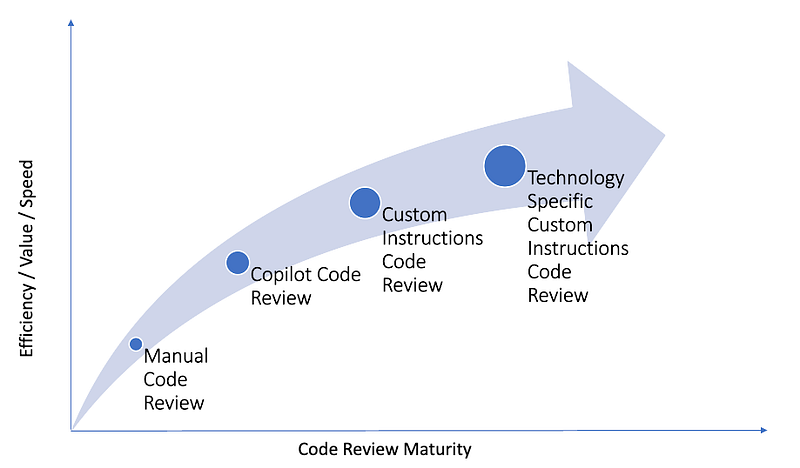
The Four Stages of Code Review Evolution
Think of code review maturity as a journey, not a destination. Each stage builds on the last, delivering compounding benefits in speed, quality, and team sanity.
Stage 1: Manual Code Review — The Necessary Grind
We’ve all been here. A developer opens a pull request. You context-switch from your work, spend 20 minutes re-familiarizing yourself with the codebase, and start hunting for issues line by line. You catch the obvious stuff — formatting inconsistencies, unused variables, maybe a logic bug if you’re lucky.
But here’s what you miss: subtle performance issues, security vulnerabilities hiding in plain sight, and architectural patterns that don’t align with your standards. Why? Because you’re human, you’re tired, and you’ve got seventeen other PRs waiting.
The reality: Manual reviews are better than nothing, but they’re slow, inconsistent, and they burn people out.
Stage 2: Copilot Code Review — Your First AI Partner
This is where things get interesting. GitHub Copilot isn’t just for writing code — it can review it too. And when you bring AI into your review process, something magical happens: the tedious stuff vanishes.
Copilot spots syntax errors, flags potential bugs, and catches patterns you might miss after staring at code for hours. Suddenly, you’re not hunting for missing semicolons — you’re thinking about architecture, business logic, and edge cases.
The shift: You move from being a syntax checker to being a strategic reviewer. Your brain gets to do what it does best: think critically about design and intent.
Stage 3: Custom Instructions Code Review — Teaching AI Your Standards
Here’s where most teams stop. But here’s also where the real power begins.
Generic AI reviews are helpful, but they don’t know your codebase, your standards, or your pain points. Custom instructions change that. You teach the AI what matters to your team: your naming conventions, your architectural patterns, your specific security requirements.
For us, this meant encoding things like:
- “Flag any dbt models without proper documentation”
- “Ensure all data transformations include data quality checks”
- “Check for PII handling compliance with our governance standards”
The difference: Reviews become consistent. New team members get the same feedback as veterans. Your tribal knowledge becomes codified and scalable.
Stage 4: Technology-Specific Custom Instructions — Mastery
This is the summit. This is where code reviews become not just efficient, but genuinely intelligent.
Instead of generic instructions, you create technology-specific instruction sets. Your dbt reviews check for different things than your Python reviews. Your Airflow DAG reviews focus on idempotency and retry logic. Your infrastructure-as-code reviews verify security groups and cost optimization.
The AI becomes a domain expert in each technology in your stack.
The payoff: Reviews happen faster, catch more issues, and actually teach developers better practices. Junior engineers learn from AI-generated feedback that’s tailored to the specific technology they’re working with.
Why This Matters More Than You Think
I know what you’re thinking: “This sounds nice, but is it really worth the effort?”
Let me answer with numbers from our own journey:
- Review cycle time dropped from 2–3 days to hours
- Critical issues caught in review increased by 40%
- Time spent on manual review decreased by 60%
- Developer satisfaction with code review went up
But here’s the less obvious benefit: we’re building better engineers. When AI handles the mechanical checks, reviewers focus on mentoring. When feedback is consistent and educational, developers learn faster.
The Bottom Line
Code review maturity isn’t about replacing humans with AI. It’s about giving humans superpowers.
Manual reviews will always have a place — for nuanced architectural discussions, for mentoring, for the human judgment that AI can’t replicate. But for everything else? Let AI handle it. Your team will thank you, your code quality will improve, and you’ll wonder how you ever did reviews any other way.
The question isn’t whether to evolve your code review process. The question is: which stage are you at, and what’s your next step?
This article was originally published at https://medium.com/@aradsouza/the-code-review-journey-from-manual-slog-to-ai-powered-efficiency-51e7fa477877