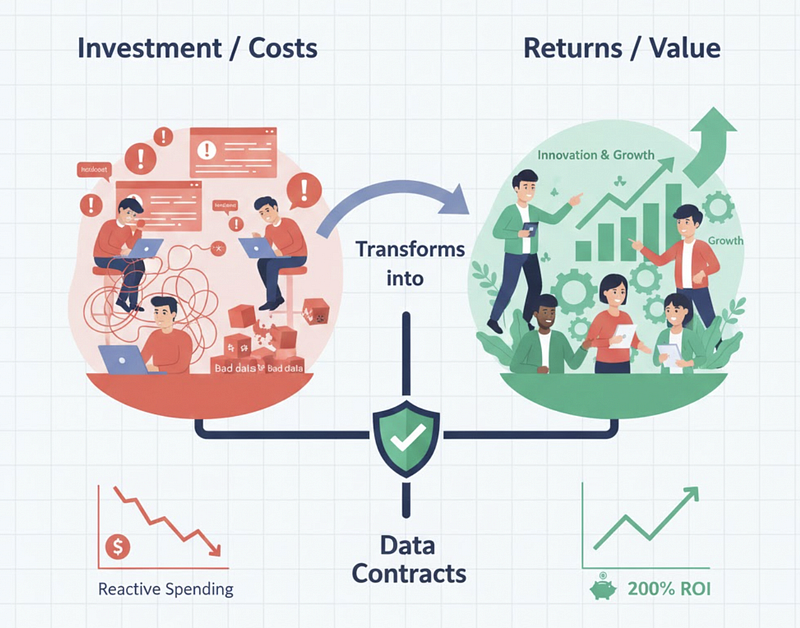
Show your CTO the numbers that justify the investment
The Question Every Leader Asks
“Why invest engineering time in data contracts when we have features to ship?”
Fair question. But here’s the hidden truth in your incident logs: You’re already paying for data quality — reactively, expensively, unpredictably.
Data contracts shift costs from reactive firefighting to proactive prevention. The ROI is measurable, substantial, and fast.
The Hidden Costs You’re Already Paying
Pull your incident logs. Count data quality issues from last quarter:
- Pipeline failures
- Schema changes breaking systems
- Missing/incorrect data in reports
- Compliance incidents
Calculate the engineering hours spent investigating and resolving each.
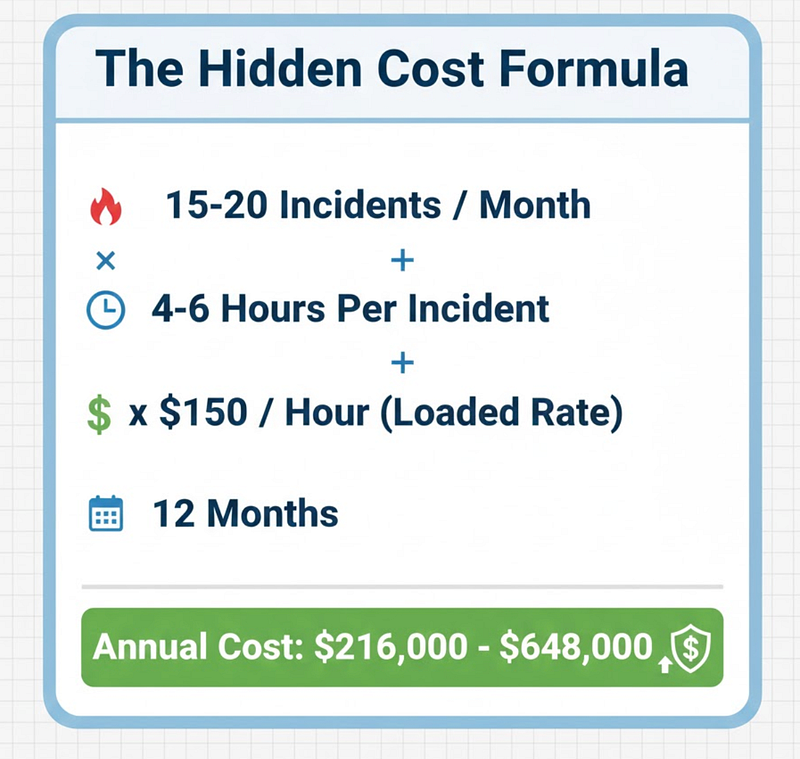
Typical Pattern Without Contracts
Incidents: 15–20 critical issues/month
Resolution: 4–6 hours average per incident
Engineers: 2–3 involved in most investigations
Total: 120–360 engineering hours/month on firefighting
At $150/hour blended rate: $18K-$54K monthly
Annual cost: $216K-$648K in incident response alone
And that’s just direct costs. Add:
- Stakeholder validation time (analysts manually checking data)
- Delayed decisions (waiting for “real numbers”)
- Opportunity cost (features not built while firefighting)
The ROI of Data Contracts: Real Numbers
Now let’s look at what changes when you implement data contracts systematically.
70% Reduction in Data Incidents
Organizations with mature data contract implementations report dramatic drops in production issues. The mechanism is straightforward: proactive validation at the source prevents most issues from ever entering your systems.
If you’re currently handling 15–20 critical incidents per month, that drops to 2–3. Your monthly incident response time falls from 120–360 hours to 15–45 hours. Annual savings: $160,000-$480,000 in direct engineering costs.
But the savings compound beyond direct hours. Fewer incidents mean:
- Reduced on-call burden (happier engineers, lower turnover)
- Less context switching (higher productivity on planned work)
- Fewer emergency escalations (preserved stakeholder relationships)
60% Faster Issue Resolution
When issues do occur with data contracts in place, they’re caught faster and resolved quickly. Instead of discovering problems days later through stakeholder complaints, contract violations are detected immediately when code is deployed.
Mean time to detection (MTTD) drops from days to seconds. Mean time to resolution (MTTR) falls from 4–6 hours to 15–30 minutes. The investigation that used to require tracing through layers of transformations now points directly to the contract violation with clear error messages.
This speed improvement has cascading benefits:
- Problems are fixed while the context is fresh (easier debugging)
- Bad data doesn’t propagate through multiple systems (contained blast radius)
- Stakeholders maintain trust (proactive communication, quick fixes)
40% Less Engineering Overhead
When you’re not spending 60–80% of your time on data quality firefighting, engineering bandwidth opens up for value creation. Teams report shifting from 70/30 reactive/proactive work to 20/80 or better.
What does your team do with that reclaimed time?
- Build new data products that drive business value
- Implement advanced analytics capabilities
- Improve platform performance and scalability
- Reduce technical debt
- Innovate on ML/AI applications
The opportunity value of this bandwidth often exceeds the direct cost savings from reduced incidents.
85% Improved Data Trust
Perhaps the most valuable but hardest to quantify: stakeholder confidence in data increases dramatically. When consumers know that data has been validated at the source with automated contracts, they stop second-guessing every number.
This trust enables:
- Self-service analytics (users don’t need hand-holding)
- Faster decision-making (no delays waiting for “validated” numbers)
- Reduced analytics team burden (fewer ad-hoc validation requests)
- Broader data democratisation (more users can safely access data)
Organisations measure this through Net Promoter Score (NPS) surveys of data consumers, tracking escalations and complaints, and monitoring self-service adoption rates.
Additional ROI Drivers
Accelerated Onboarding
50% faster startup for new analytics use cases. Read the contract, understand guarantees, start using — no trial and error learning quirks.
Reduced Compliance Risk
Automated governance prevents violations. Lower probability of regulatory fines (single GDPR fine = millions of euros).
Faster Time-to-Insight
An analyst who spent 2 days validating now concludes in 2 hours. Multiply across the analytics organisation.
Improved Collaboration
Clear contracts = clear interfaces between teams. Less friction, miscommunication, and finger-pointing.
Addressing Common Objections
“We don’t have time with the current workload”
Response: You’re already spending the time — reactively. Contracts shift to proactive prevention (more efficient). Investment pays back in 3–6 months.
“Our data is too complex for simple contracts”
Response: Start simple with basic schema validation. Each contract delivers value. Sophistication comes later.
“We’ll lose velocity maintaining contracts”
Response: Contracts are evergreen, need minimal maintenance. Velocity gain from reduced firefighting far exceeds overhead.
“Producers won’t adopt this”
Response: Show value. When engineers see contracts that prevent production breaks, they appreciate the safety net. Start with willing teams.
This article was originally published at https://medium.com/@aradsouza/the-business-case-for-data-contracts-quantifying-roi-43e7dee65308