Why Security Can’t Be an Afterthought in AI Development
Artificial intelligence is no longer a futuristic concept — it’s embedded in our daily lives. From voice assistants that understand our commands to automated financial systems managing millions of transactions, AI-powered technologies have become indispensable. But as we increasingly rely on these intelligent systems, a critical question emerges: How do we ensure they’re secure and reliable?
The answer lies in MLSecOps — Machine Learning Security Operations — a systematic approach to building security into every stage of the AI lifecycle.
What Exactly Is MLSecOps?
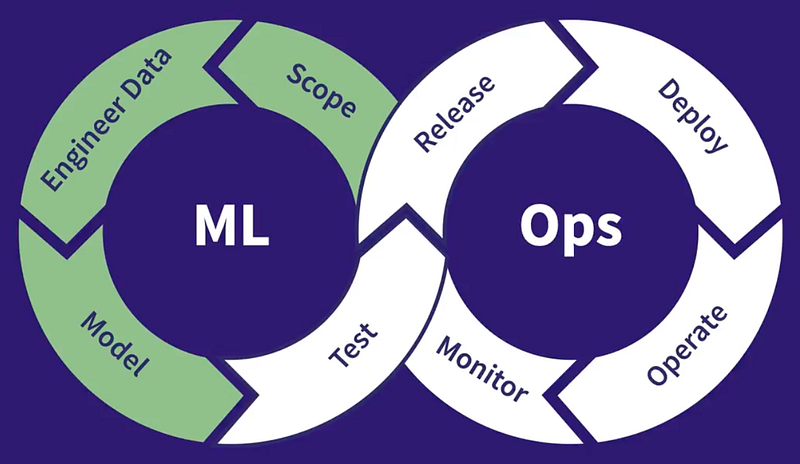
Credits to ProtectAI — https://mlsecops.com/what-is-mlsecops
Think of MLSecOps as the natural evolution of DevSecOps, specifically tailored for the unique challenges of artificial intelligence and machine learning. While DevSecOps brought security into traditional software development, MLSecOps extends these principles to address the distinctive vulnerabilities that come with AI systems.
At its core, MLSecOps integrates security practices throughout the entire machine learning pipeline — from initial data collection and model development to deployment and continuous monitoring. It’s not just about protecting code; it’s about securing data, models, and the complex processes that make AI work.
Understanding the Foundation: AI vs. ML
Before we dive deeper, let’s clarify two terms that are often used interchangeably but aren’t quite synonymous:
Artificial Intelligence (AI) encompasses the broader concept of machines performing tasks that typically require human intelligence — understanding natural language, recognizing patterns, making decisions, and solving complex problems.
Machine Learning (ML) is a subset of AI that enables systems to learn and improve from data without being explicitly programmed for every scenario.
Consider a major financial institution using AI for fraud detection. The AI system oversees the entire fraud detection process, but it’s the carefully tuned ML models — trained to analyze transaction data and learn spending patterns — that identify unusual behavior and adapt over time. The ML models are the engine that powers the AI’s intelligence.
Why MLSecOps Matters Now More Than Ever
The consequences of unsecured AI systems aren’t theoretical — they’re potentially catastrophic:
In Transportation: Imagine hackers manipulating an autonomous vehicle’s decision-making process. The safety implications are immediate and severe.
In Healthcare: An AI diagnostic system compromised by malicious actors could lead to incorrect medical treatments, putting lives at risk.
In Finance: A corrupted AI trading algorithm could trigger market manipulation, regulatory violations, and massive financial losses.
These aren’t scare tactics — they’re realistic scenarios that organizations must prepare for. AI and ML systems face threats at multiple levels, from supply chain vulnerabilities to sophisticated adversarial attacks designed to manipulate model outcomes.
The Evolution: From DevOps to MLSecOps
The journey to MLSecOps follows a clear evolutionary path:
- DevOps automated software development and deployment
- DevSecOps introduced security early in the development process — the “Shift Left” principle
- MLOps adapted DevOps practices for machine learning’s unique challenges
- MLSecOps brings security into MLOps, addressing AI-specific threats
What makes ML different from traditional software? Unlike conventional applications that primarily deal with code, ML systems involve complex data handling, continuous model training, and dynamic learning processes. These introduce unique vulnerabilities that standard DevSecOps practices don’t fully address.
The Five Pillars of MLSecOps Assurance
Effective MLSecOps is built on five critical categories of assurance:
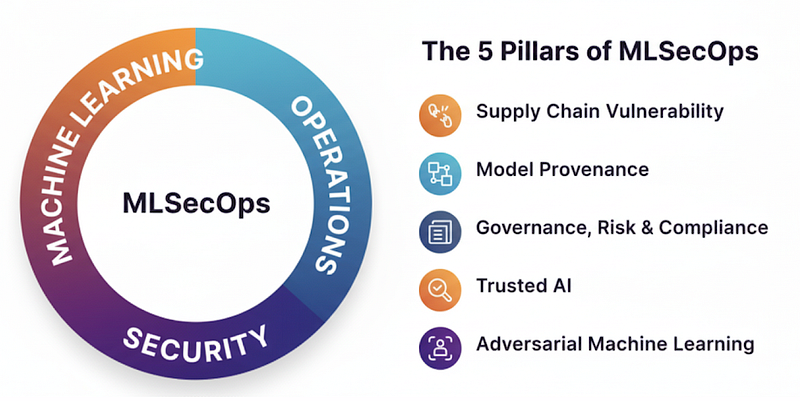
1. Supply Chain Vulnerability
AI supply chains are complex ecosystems. A vulnerability anywhere in the chain — from data sources to pre-trained models downloaded from repositories — can be exploited to compromise entire systems.
2. Model Provenance
With 80% of ML and analytics artifacts being open source, tracking a model’s complete history — its development, modifications, and deployment — is essential for identifying potential security issues.
3. Governance, Risk, and Compliance (GRC)
Strong governance ensures responsible ML use through regular audits assessing fairness, transparency, and accountability. The Machine Learning Bill of Materials (ML-BOM) provides a comprehensive inventory of all components used in model development, helping identify vulnerabilities.
4. Trusted AI
AI systems must be fair, unbiased, and explainable. We need AI to make equitable decisions regardless of race, gender, age, or other characteristics, without perpetuating existing biases. Transparency and explainability are key to achieving trust.
5. Adversarial Machine Learning
This field focuses on understanding and defending against attacks on ML systems — from manipulating input data to cause incorrect predictions to altering models themselves to reduce accuracy or cause unexpected behaviors.
Building a Successful MLSecOps Program
Implementing MLSecOps isn’t just about technology — it’s about people, processes, and tools working together. Here are the essential strategies:
Assemble a Cross-Functional Team: Break down silos between data scientists, security professionals, and operations teams. MLSecOps requires collaboration across disciplines.
Invest in Education: Provide hands-on training to help team members understand ML-specific security risks and mitigation strategies.
Deploy ML-Aware Tools: Traditional security tools weren’t designed for ML contexts. Invest in or develop tools that understand the unique risks of machine learning systems.
Implement Policy as Code: Automate security policies specifically for ML models to ensure consistent enforcement across all deployments.
Prioritize Privacy and Data Security: Given ML’s dependence on data, protecting sensitive information throughout the pipeline is paramount.
Monitor Continuously: ML models in production need ongoing surveillance. Continuous monitoring provides feedback that improves security across the entire MLSecOps loop.
The Path Forward
As AI and ML continue to transform industries, the risks associated with these technologies will only grow more complex. Organizations can no longer treat security as an afterthought or bolt-on feature. MLSecOps represents a fundamental shift in how we approach AI development — embedding security from the very beginning.
The question isn’t whether your organization should adopt MLSecOps practices, but how quickly you can implement them. In a world where AI systems make critical decisions affecting safety, health, and financial security, building inherently secure AI isn’t just a best practice — it’s an imperative.
By embracing MLSecOps, organizations can harness the transformative potential of AI while ensuring these systems remain secure, reliable, and trustworthy. The future of AI is bright, but only if we build it on a foundation of security.
This article was originally published at https://medium.com/@aradsouza/mlsecops-securing-the-future-of-ai-and-machine-learning-61e9004e1a10