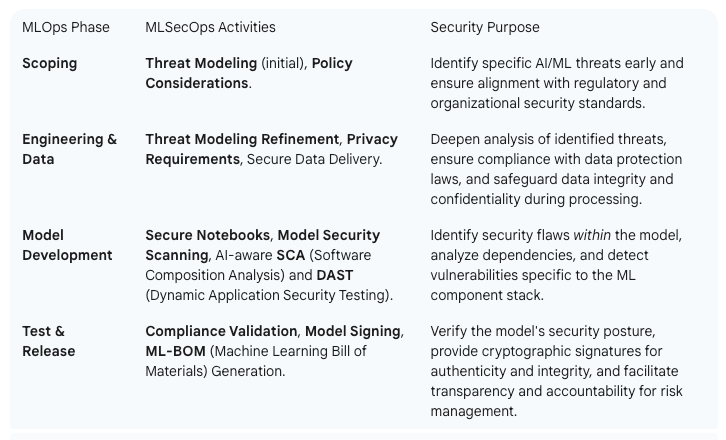
Successfully implementing MLSecOps requires infusing security practices directly into the existing MLOps pipeline. This strategy, built on the pillars of people, processes, and technology, ensures that AI systems are secured from conception to deployment and beyond.
Step-by-Step: Infusing MLSecOps into Existing Processes
MLSecOps activities must be integrated into every phase of the ML lifecycle (scoping, engineering, model development, testing, and release) to ensure continuous security.
Model signing, in particular, is critical, as it provides verifiable cryptographic signatures to ensure the authenticity and integrity of ML models throughout deployment and distribution.
Foundations for AI/ML Risk Assessments and Assurance
The MLSecOps approach establishes the technical activities that implement the principles outlined in the NIST AI Risk Management Framework (AI RMF), organizing AI assurance into four key functions: Map, Measure, Manage, and Govern.
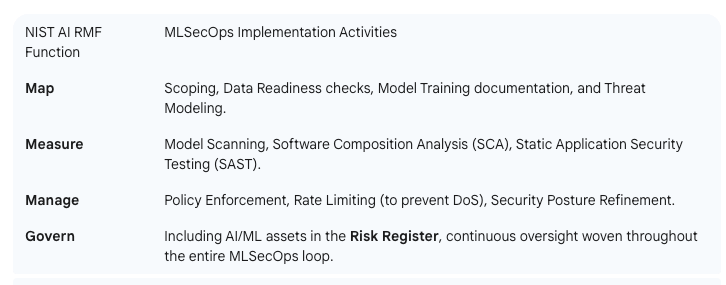
Crucially, Governance is a cross-cutting function. By including AI and ML assets in the organization’s risk register, these systems are formally tracked alongside other critical business assets. This enables effective monitoring of their performance, vulnerabilities, and potential business impacts, driving proactive risk mitigation and responsible deployment.
AI Incident Response Plans
Effective MLSecOps requires extending traditional incident response plans to address AI-specific risks.
Traditional incident response steps (Preparation, Detection, Containment, Eradication, Recovery, Post-Incident Activity) must be augmented with strategies to handle:
- Model Failures
- Data Drift (model decay)
- Adversarial Machine Learning Attacks (e.g., model poisoning, evasion).
Key NIST/MLSecOps Actions for AI Incidents
The NIST AI RMF emphasizes several proactive measures for incident management, typically covered under the Manage and Govern functions:
- Policy Establishment: Creating policies for reporting, documenting, and publicly disclosing AI incidents.
- AI-Specific Guidelines: Establishing guidelines tailored to the risks and performance characteristics of AI systems.
- Information Sharing: Implementing a mechanism to share information about errors, near misses, and attack patterns with incident databases or similar organizations.
The Criticality of Recovery
The Recovery step is paramount in an ML environment. In the event of a compromised ML model, damage can include data breaches, financial losses, or disruption to business operations. Mitigation involves:
- Swift Containment: Promptly removing affected models from production.
- Rollback Procedures: Initiating a rollback to restore the model to its uncompromised state. This requires meticulous planning, version control mechanisms, and regular backups of model configurations and datasets.
Adapting incident response plans to the full AI lifecycle is imperative for ensuring resilience and security in the face of today’s rapidly evolving AI threat landscape.
Audit, Inventory, and Supply Chain Integrity
Whether models are built in-house, purchased, or acquired from open-source libraries, they are critical assets. AI-aware auditing and comprehensive inventory management provide the visibility needed to manage risks.
The Role of the ML-BOM and Auditing
An audit of AI systems utilizes inventory and supply chain information — including system operation, origin, build process, connections, and impact on decision-making.
The ML-BOM is the foundation for auditing, capturing:
- Training data sources and versions.
- Algorithms in use.
- Model versioning.
- Who trained and validated the model.
Auditing is essential because it:
- Ensures Accountability and Transparency: Shines a light on potential bias, vulnerabilities, and errors, providing stakeholders assurance that decisions are being made fairly.
- Strengthens Risk Management: Proactively identifies and mitigates risks before they escalate into major issues.
- Fosters Trust: Provides insight into the model’s inner workings, helping to identify the precise reason for a failure.
Regulatory Standards and Actions
Regulatory bodies worldwide are recognizing the need for formal AI risk assurance. Key standards and legislation driving this push include:
- The EU AI Act.
- ISO/IEC 5338 on AI system lifecycle processes.
- OWASP’s AI Security and Privacy Guide.
- The US 2023 Executive Order on safe, secure, and trustworthy AI.
To initiate AI/ML auditing, organizations must create a comprehensive inventory of the entire ML supply chain, capturing training methodologies, dependencies, and data sources. Consistent and frequent auditing provides immediate visibility, enabling proactive incident prevention and effective risk management.
This article was originally published at https://medium.com/@aradsouza/mlsecops-implementation-and-strategy-securing-the-ai-lifecycle-7ee53af8802b