I have been giving a lot of thought to how we design and structure data architecture to effectively support AI initiatives.
Here is something that hit me: we have been doing it backwards.
For years, we have built data pipelines first, then tried to make AI understand them. But what if we flipped that? What if we designed our architecture to speak AI’s language from day one?
That’s exactly what an ontology-first approach does.
I have used Palantir Foundry to explore the concept.
It’s Not Just About Moving Data Anymore
I used to think data transformation was the endgame. Clean it, move it, store it. Done.
But here is the reality: data without context is just noise.
A table of numbers doesn’t tell you if that “John Smith” is a customer, an employee, or both. It doesn’t know that “Chicago” refers to a location, not just a string.
That’s where ontology changes everything.
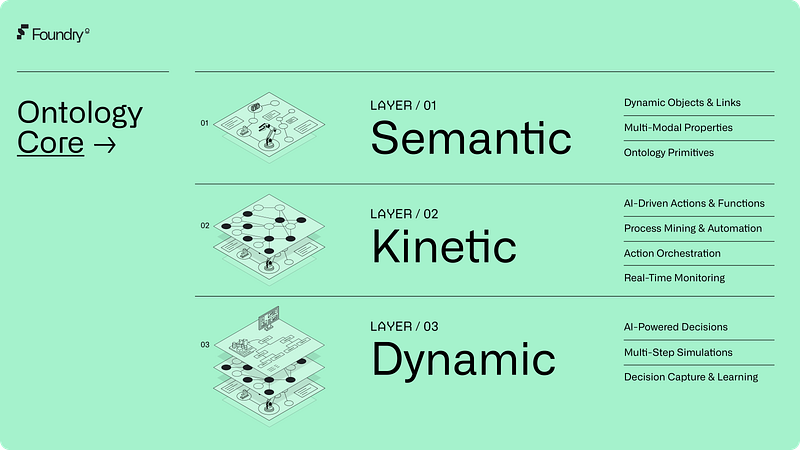
The Three Layers That Actually Matter
Think of building with ontology like constructing a building.
🧠 The Semantic Layer — Your Blueprint
This is where you define what exists in your world. Who are the people? What are the assets? How do things connect?
It’s not technical. It’s human. It answers: “What matters to our business?”
Example: A “Customer” isn’t just row 47 in table_users. It’s a person with relationships, history, and context.
🔗 The Kinetic Layer — Your Foundation
This connects your beautiful blueprint to messy reality.
Your SQL tables, APIs, CSV files — they all map into your ontology here. It’s the bridge between “what we want” and “what we have.”
The magic? Full data lineage. You can trace every insight back to its source.
⚡ The Dynamic Layer — Your Living System
This is where it gets interesting.
Business rules. Access controls. Workflows. This layer makes your ontology do things.
- “Can this person access that case?”
- “Should this alert trigger?”
- “Who needs to approve this?”
It’s not static — it evolves with your business.
Why This Matters Now
We are not just building dashboards anymore. We are building systems that need to understand and act.
AI agents need context. They need to know that deleting a “Customer” record has downstream impacts. That certain data is sensitive. That relationships matter.
An ontology gives AI the worldview it needs to be useful, not just accurate.
The Mindset Shift
Stop thinking: “How do we structure data for storage?”
Start thinking: “How do we model our world so both humans AND machines understand it?”
That’s the future of data engineering.
References
[**#dataengineering #ai #ontology #aiagents #dataarchitecture #futureofdata #semanticlayer…**
*𝗙𝘂𝘁𝘂𝗿𝗲 𝗼𝗳 𝗗𝗮𝘁𝗮 𝗘𝗻𝗴𝗶𝗻𝗲𝗲𝗿𝗶𝗻𝗴 : 𝗪𝗵𝘆 𝗬𝗼𝘂𝗿 𝗢𝗻𝘁𝗼𝗹𝗼𝗴𝘆 𝗟𝗮𝘆𝗲𝗿 𝗠𝗮𝘁𝘁𝗲𝗿𝘀 𝗠𝗼𝗿𝗲…*www.linkedin.com](https://www.linkedin.com/posts/alwynanildsouza_dataengineering-ai-ontology-activity-7387386347369480192-PwT1?utm_source=share&utm_medium=member_desktop&rcm=ACoAAAMP4VsBrtwWcNBrVW9wKterBK9NKpQNbYk "https://www.linkedin.com/posts/alwynanildsouza_dataengineering-ai-ontology-activity-7387386347369480192-PwT1?utm_source=share&utm_medium=member_desktop&rcm=ACoAAAMP4VsBrtwWcNBrVW9wKterBK9NKpQNbYk")[**Palantir**\
*The Palantir Ontology is an operational layer for the organization. The Ontology sits on top of the digital assets…*www.palantir.com](https://www.palantir.com/docs/foundry/ontology/overview "https://www.palantir.com/docs/foundry/ontology/overview")
This article was originally published at https://medium.com/@aradsouza/future-of-data-engineering-why-your-ontology-layer-matters-more-than-ever-187f848d288a