How to seamlessly integrate traditional DevOps practices with machine learning operations for end-to-end automation
The journey from raw data to a deployed, performing machine learning model is complex, often fraught with challenges around data quality, model governance, and operational efficiency. To navigate this landscape successfully, organisations are increasingly adopting integrated DataOps and MLOps strategies.
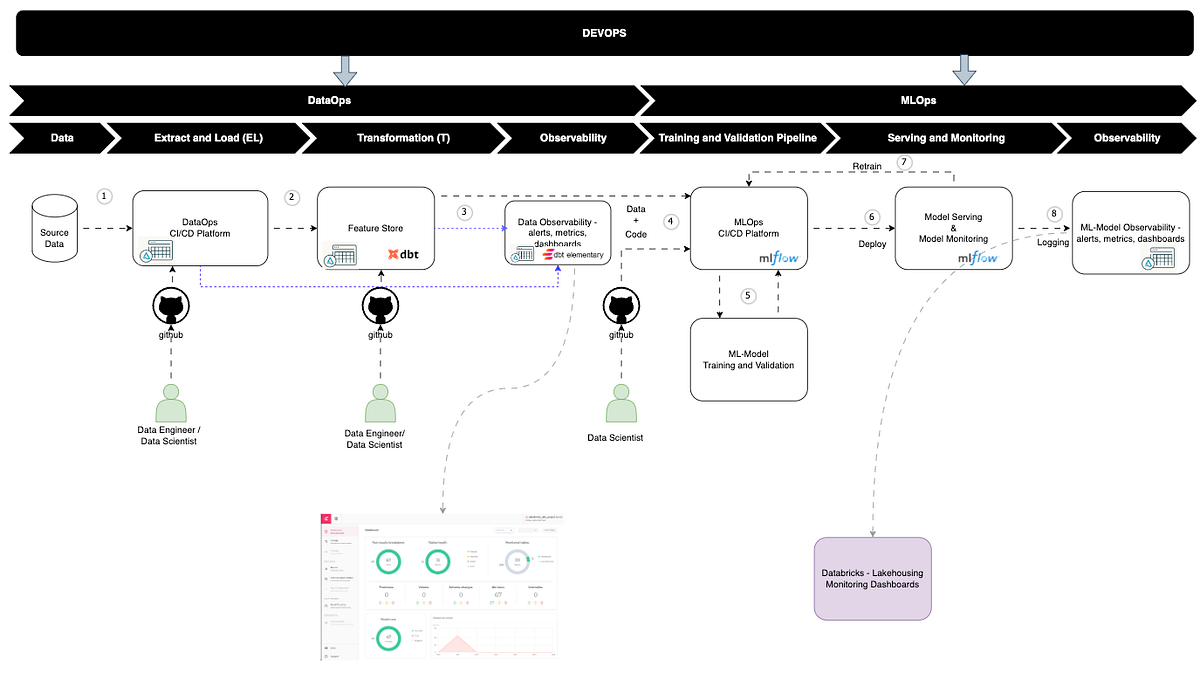
This article breaks down a typical modern ML lifecycle, highlighting the critical interplay between DataOps, which focuses on reliable data delivery, and MLOps, which orchestrates the machine learning workflow.
Let’s dive into the key stages:
The DataOps Foundation: Building a Robust Data Backbone
DataOps is all about ensuring that data is readily available, high-quality, and trustworthy for downstream consumption, especially by machine learning models. It emphasises collaboration, automation, and continuous delivery across data pipelines.
- Extract and Load (EL): The Ingestion Point. Our journey begins with data extraction. Data pipelines are meticulously built to extract raw data, often from source systems. Once extracted, this data is then loaded into a powerful, scalable environment like Databricks, ready for the next phase of transformation. This initial step is crucial for establishing a single source of truth.
- Transformation (T): Crafting Features for Intelligence. Once loaded, the raw data undergoes a significant transformation. Here, data pipelines are designed not just to clean and refine data, but also to engineer and maintain a Feature Store. A feature store is a centralised repository that manages and serves consistent, high-quality features for machine learning models. This ensures reusability, consistency, and reduces redundant feature engineering efforts across different models.
- Data Observability: Trusting Your Data. A critical, often overlooked, aspect of DataOps is Data Observability. Dedicated dashboards are built to continuously monitor data quality checks and tests. This proactive approach helps identify and alert on anomalies, inconsistencies, or drifts in the data early in the pipeline, preventing bad data from poisoning your models and leading to flawed insights. Think of it as the health monitor for your data.
The MLOps Engine: From Experimentation to Production
MLOps extends DevOps principles to the machine learning lifecycle, focusing on automation, reproducibility, and governance for building, deploying, and managing ML models in production.
Build Phase: Crafting the Model
- Model Development: The Genesis of Intelligence. This is where the magic of machine learning truly begins. Data scientists combine meticulously prepared data (courtesy of DataOps) with their code to build and iterate on ML models. This phase involves extensive experimentation, feature selection, algorithm choice, and initial model training. It’s where new ML models are typically created or existing ones are fine-tuned for specific tasks.
- Model Training and Validation Pipeline: The Rigorous Testing Ground. Once a model architecture is established, robust pipelines are built specifically for training and validating these ML models. These pipelines automate the process of feeding data to the model, training it on various datasets, and rigorously validating its performance against predefined metrics. This ensures that models are well-trained, generalise effectively, and meet the necessary performance benchmarks before moving to deployment.
Deploy Phase: Bringing Models to Life
- Model Serving and Monitoring: Live in Production. With models rigorously trained and validated, they are ready for prime time. In this stage, ML models are deployed into production environments for real-time model serving and inference. But deployment isn’t the end; it’s just the beginning of continuous oversight. Robust monitoring jobs are implemented to constantly check for critical issues like data drift (when the characteristics of the production data diverge from the data the model was trained on) and model performance degradation (when the model’s accuracy or other metrics fall below acceptable thresholds).
- Model Retraining: Adapting to Change. The world is dynamic, and so should be our models. Model performance is continuously monitored in production. If the performance falls below a predefined threshold — indicating, for example, a significant data drift or concept drift — an automated or semi-automated model retraining process is triggered. This ensures that models remain relevant and accurate over time, adapting to new data patterns and changing real-world conditions.
The Observability Layer: Continuous Insight and Improvement
Observability Dashboards: A Single Pane of Glass. Beyond individual monitoring, a comprehensive observability layer is crucial for holistic insight. The results from inferencing and monitoring pipelines are meticulously logged into dedicated metrics and inference tables. These tables feed into intuitive dashboards (like Databricks Lakehousing Monitoring Dashboards, as indicated in our diagram) that provide continuous performance tracking, allowing stakeholders to visualise model health, identify trends, and quickly diagnose issues. This continuous feedback loop is vital for iterative improvement and ensuring the long-term success of ML initiatives.
The Synergy: DevOps, DataOps, and MLOps
As the diagram clearly illustrates, DevOps provides the overarching philosophy and tooling for automation and collaboration. DataOps ensures the continuous delivery of high-quality data. And MLOps operationalises the machine learning lifecycle. When these three disciplines work in harmony, organisations can achieve faster time-to-value for their ML investments, build more reliable models, and drive continuous innovation.
Best Practices for Implementation
Start Small, Scale Gradually
Begin with a single use case and gradually expand the pipeline. This allows teams to learn and iterate without overwhelming complexity.
Invest in Monitoring Early
Don’t wait until production to think about observability. Build monitoring and alerting into every stage of the pipeline from day one.
Automate Everything Possible
Manual processes are error-prone and don’t scale. Invest in automation for data validation, model testing, and deployment processes.
Foster Cross-Functional Collaboration
Break down silos between data teams, engineering teams, and business stakeholders. Regular communication and shared responsibilities are key.
Document Extensively
ML pipelines are complex systems with many moving parts. Comprehensive documentation is essential for maintenance and knowledge transfer.
Common Pitfalls and How to Avoid Them
Data Drift Goes Unnoticed
Solution: Implement automated data quality checks and drift detection at every stage.
Model Performance Degrades Silently
Solution: Set up comprehensive monitoring with business-relevant metrics, not just technical ones.
Inconsistent Feature Engineering
Solution: Centralise feature definitions in a feature store and enforce consistency across training and serving.
Lack of Model Lineage
Solution: Track everything — data versions, code versions, hyperparameters, and model artefacts.
The Future of MLOps
As this field continues to evolve, we’re seeing trends toward:
- Real-time ML: Streaming data processing and online learning
- AutoML Integration: Automated model selection and hyperparameter tuning
- Edge ML: Deploying models closer to data sources
- Responsible AI: Built-in fairness, explainability, and bias detection
The transition from DevOps to MLOps represents more than just adding new tools to your stack — it’s about adopting a mindset that treats machine learning as a continuous, collaborative process rather than a one-time research project.
Success requires investment in three key areas: robust data infrastructure, comprehensive monitoring and observability, and strong cross-functional collaboration. By building these foundations, organisations can move beyond proof-of-concept models to production systems that deliver real business value.
The pipeline architecture shown here provides a roadmap for this journey, but remember that every organisation’s needs are unique. Start with the fundamentals, measure everything, and iterate based on what you learn.
This article was originally published at https://medium.com/@aradsouza/devops-to-mlops-building-a-complete-data-to-model-pipeline-cdfa38d58f14