How dbt MCP v1.20.0 fixes a subtle but important problem in AI-assisted analytics engineering
Overview
dbt MCP v1.20.0 introduces version-aware documentation retrieval. That means AI agents can now answer questions using the documentation that matches your project’s dbt version — not simply the latest docs.
It sounds like a small enhancement, but it addresses one of the biggest reliability gaps in AI-assisted analytics engineering: ensuring agents are grounded in the context of the environment where they’ll actually execute.
The Problem Nobody Said Out Loud
When the dbt MCP server first arrived, the value proposition was obvious.
Instead of relying on stale model training data, AI agents could access live dbt documentation directly through MCP tools.
That was a significant step forward.
After all, dbt evolves quickly. If an AI agent is generating code based on patterns learned from an older version of dbt, it may produce deprecated configurations, outdated YAML structures, or syntax that no longer exists.
Giving agents access to current documentation seemed like the perfect solution.
But there was a problem hiding beneath the surface.
What if the documentation is too new for your project?
If your production environment is running dbt 1.8 and an AI agent retrieves documentation written for dbt 1.12, the agent may confidently recommend features that don’t exist in your environment.
The answer is still wrong.
It just has a citation attached to it.
The real challenge was never:
Docs versus no docs.
It was:
How do we ensure agents use the right docs for this repository?
When “Correct” Becomes Wrong
Consider a simple example.
An analytics engineer asks:
“Generate a semantic model for customer revenue.”
An AI agent connected to the latest documentation might generate code using syntax introduced in a newer dbt release.
The generated code may look completely valid.
It may even be copied directly from official documentation.
But if the project is running an older version of dbt, validation fails immediately.
The agent wasn’t hallucinating.
The documentation wasn’t incorrect.
The problem was context.
The agent answered using the wrong version of reality.
This is exactly the gap that dbt MCP v1.20.0 closes.
What dbt MCP v1.20.0 Actually Ships
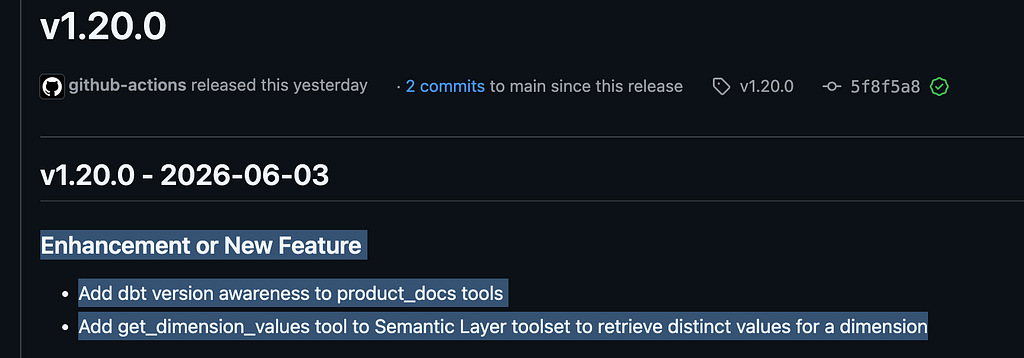
The release note is refreshingly concise:
Add dbt version awareness to product_docs tools
Under the hood, the MCP server now detects the dbt version installed in the active environment and scopes documentation responses accordingly.
When an AI agent asks a documentation question through the product_docs tools, the answer is now grounded in the version of dbt actually running in that project.
The release also introduces a new Semantic Layer capability:
get_dimension_values
This tool retrieves distinct values for a dimension, making it easier for agents to perform exploratory metric analysis and build richer Semantic Layer workflows.
Useful addition.
But version-aware documentation is unquestionably the headline feature.
The Real Lesson: Context Beats Knowledge
This release highlights a broader principle that applies across agentic data engineering.
Agents don’t simply need more knowledge.
They need contextual knowledge.
In analytics engineering, “correct” is always relative to the environment.
Documentation guidance depends on:
- Your dbt version
- Your adapter
- Your packages
- Your Semantic Layer configuration
- Your deployment architecture
For example:
- A dbt-bigquery project behaves differently from a dbt-databricks project.
- dbt-utils 0.9 and dbt-utils 1.x exposes different capabilities.
- Features available in dbt 1.12 may not exist in dbt 1.8.
Without context, an agent can generate technically correct answers that are operationally useless.
Version-aware documentation transforms the MCP tool from:
“Here’s how dbt works.”
to:
“Here’s how dbt works for your project in your environment right now.”
That’s a meaningful shift.
A New Non-Functional Requirement for AI Agents
When teams evaluate AI-powered developer tools, they typically focus on three dimensions:
- Accuracy
- Latency
- Cost
But agentic systems introduce a fourth requirement:
- Context Alignment
An answer can be accurate and still be wrong.
If the answer doesn’t match the environment where it will be executed, it creates risk rather than value.
As organizations deploy AI agents into production engineering workflows, context alignment becomes a critical non-functional requirement.
Version-aware documentation is a practical example of this principle in action.
The Bigger Picture
What I find most interesting about this release isn’t the feature itself.
It’s the design philosophy behind it.
The naive approach to AI tooling is: Give agents access to documentation.
The mature approach is: Give agents access to the documentation that is relevant to the environment they’re operating in.
That distinction sounds subtle. It isn’t.
As AI agents become embedded in software engineering and analytics engineering workflows, the winners won’t be the tools with the largest knowledge base.
They will be the tools with the best grounding.
Version awareness is grounding.
And grounding is what ultimately creates trust.
References
https://github.com/dbt-labs/dbt-mcp/releases/tag/v1.20.0
This article was originally published at https://aradsouza.medium.com/your-ai-agent-was-reading-the-wrong-dbt-docs-0bb3f1238189?source=rss-670f6306e3c0------2