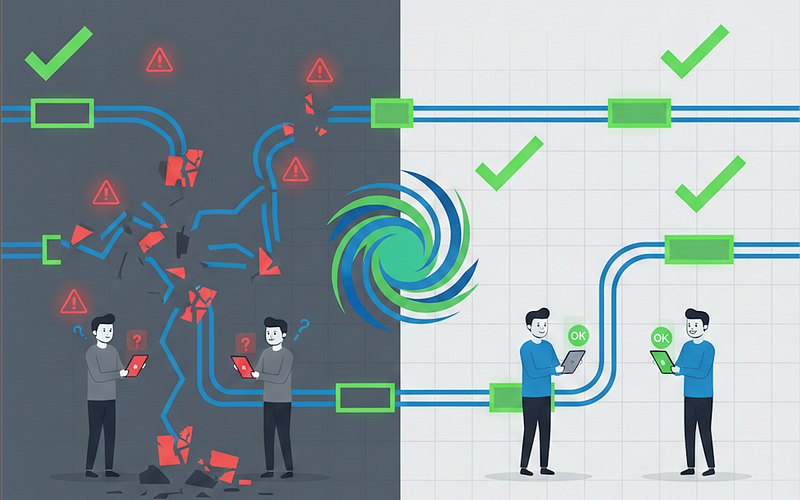
Turning 60–80% firefighting time into proactive innovation
The Pain You Know Too Well
Here’s the uncomfortable truth: most data teams spend 60–80% of their time dealing with data quality issues instead of delivering actual business value. That’s not a typo. For every ten hours your team works, six to eight are spent debugging pipeline failures, investigating schema changes that broke downstream systems, and apologising to stakeholders about missing or incorrect data in their reports.
Think about the last production incident your team handled. Maybe it went something like this:
Monday morning starts with an urgent Teams message. The executive dashboard is showing zeros where there should be revenue numbers. Your analytics team is blocked. The data science model that recommends products to customers is throwing errors. And your CEO is asking questions in the 9 AM leadership meeting.
You trace the problem back through layers of transformations, finally discovering that a backend engineer renamed a field three days ago. They had no idea anyone was using that data. The fix takes fifteen minutes, but the investigation took four hours. The trust erosion? That takes much longer to repair.
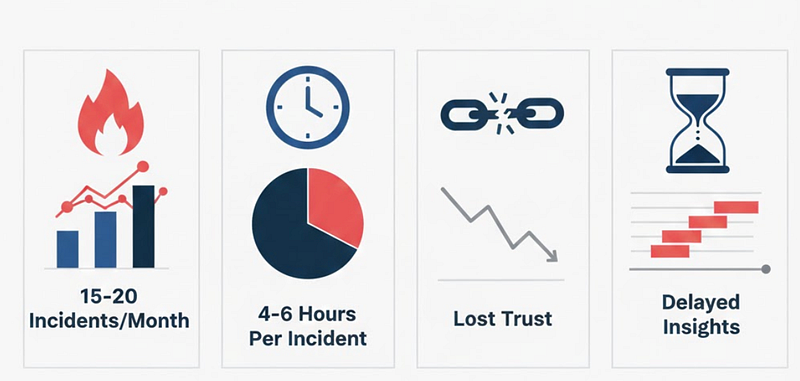
Hidden Cost of Bad Data
What Are Data Contracts?
Data contracts are formal, executable agreements between data producers and consumers. Unlike documentation that lives in a wiki and gets outdated, contracts are living code that sits alongside your data models.
Think of them as APIs for your data. You wouldn’t consume a REST API without understanding its schema and guarantees. Why consume data without clear contracts?
A comprehensive data contract specifies:
Schema definitions that ensure every field has a clear type, constraint, and structure. No more guessing whether a date field is in ISO format or epoch seconds, or whether nulls are allowed in that critical customer ID column.
Quality rules that validate completeness, accuracy, and business logic at the source. These aren’t just schema checks — they enforce business rules like “revenue must be non-negative” or “order timestamps must be within the past 24 hours.”
Clear ownership that eliminates the finger-pointing when things go wrong. Every data product has a named owner who is accountable for maintaining the contract and communicating changes.
SLA guarantees that it commits to delivery schedules, freshness requirements, and uptime standards. Your downstream consumers know they can count on daily sales data being available by 6 AM, refreshed and validated.
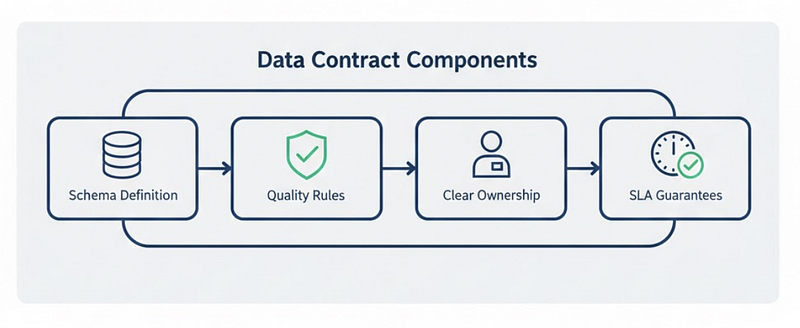
4 Pillars of Data Contracts
Traditional Governance (Reactive)
Traditional data governance follows a reactive pattern: issues are discovered downstream after bad data has already propagated through your systems, causing cascading failures and expensive fixes. It’s the equivalent of quality control inspectors at the end of an assembly line — by the time they catch defects, significant resources have already been wasted.
This approach creates several painful problems:
Late detection means expensive fixes. When you discover data quality issues in a dashboard or analytics report, the bad data has already been copied, transformed, and distributed across multiple systems. Now you need to track down every affected dataset, correct the errors, and notify all stakeholders.
Eroded trust becomes the new normal. When stakeholders can’t rely on their data, they start second-guessing every insight. Analysts waste time manually validating numbers instead of generating insights. Decision-makers delay critical choices while waiting for “the real numbers.”
Team morale suffers. Nothing burns out a data engineering team faster than constant firefighting. When you’re perpetually in reactive mode, there’s no time for innovation, no opportunity to build the features that would actually move the business forward.
Shift Left Governance (Proactive)
Data contracts flip this model. Instead of catching problems downstream, they validate data quality at the source — before it enters your pipelines, before it gets transformed, and before it can cause damage.
When a data producer implements a contract, they are committing: “This data will have these fields, in this format, meeting these quality standards, on this schedule.” That contract gets validated with every data delivery. If the producer tries to change the schema or violates a quality rule, the contract breaks — and the issue is caught immediately, before downstream systems are affected.
This shift from reactive to proactive governance delivers tangible results. Teams report 70% reductions in data incidents, 60% faster issue resolution, and 40% less engineering overhead spent on manual validation and troubleshooting. But perhaps most importantly, stakeholder confidence in data increases dramatically — from constant escalations and complaints to proactive communication and trust.
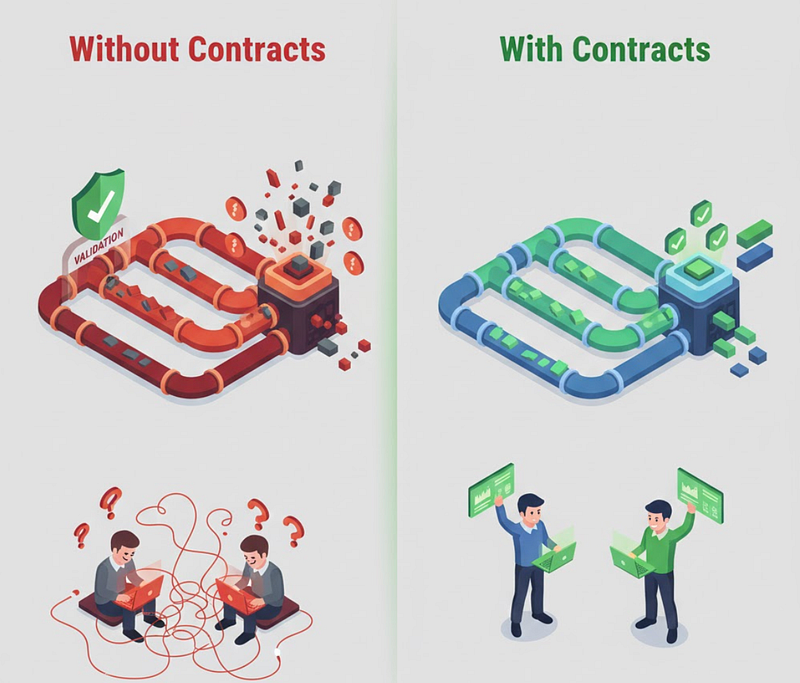
The Strategic Advantage
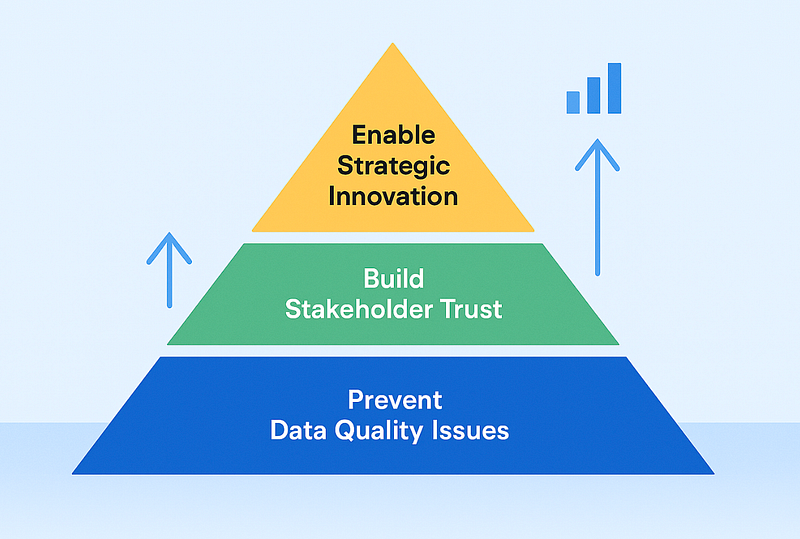
Data contracts aren’t just about preventing incidents. They’re about building competitive advantage.
When your data is trusted by default rather than validated manually, innovation accelerates. Teams ship features faster, make better decisions, and scale confidently.
Organisations with robust contracts enable self-service analytics and faster time-to-insight. Your data platform becomes a strategic asset, not a cost centre.
You are already investing in data quality — reactively. Data contracts shift your existing quality investment from reactive debugging to proactive prevention, leading to 200%+ ROI. Get loud data failures, not silent ones.
Your future self — and your stakeholders — will thank you.
This article was originally published at https://medium.com/@aradsouza/data-contracts-the-missing-link-in-your-data-engineering-strategy-7dbc1e95e208