The proliferation of Artificial Intelligence (AI) and Machine Learning (ML) across enterprise environments necessitates a dedicated, rigorous security strategy. MLSecOps (Machine Learning Security Operations) provides the necessary framework to embed security throughout the entire AI lifecycle, ensuring systems are resilient, trustworthy, and compliant.
This article details how MLSecOps aligns with established risk management standards and outlines the practical steps for integrating security, from strategic threat modeling to secure deployment.
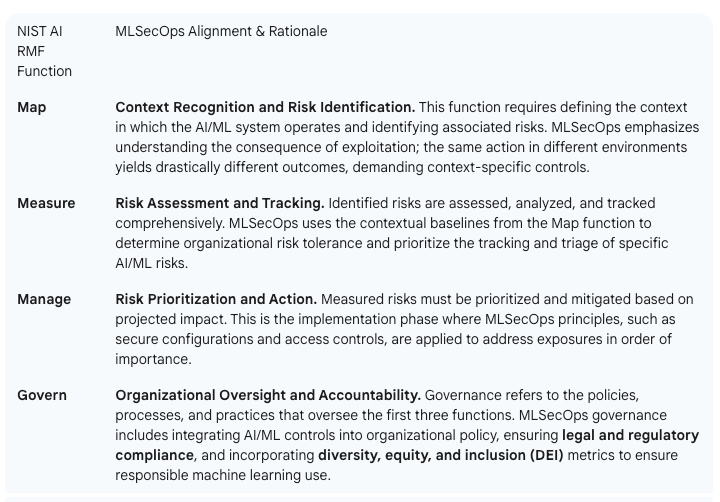
Integrating MLSecOps with the NIST AI Risk Management Framework (AI RMF)
Effective AI governance is anchored in continuous risk management. The National Institute of Standards and Technology (NIST) AI Risk Management Framework (AI RMF) offers a structured approach that perfectly complements MLSecOps practices. This framework is built upon four core, continuous functions: Map, Measure, Manage, and Govern.
NIST provides a companion AI RMF Playbook to guide organizations in practical adoption, demonstrating that combining the core functions of the AI RMF with MLSecOps principles is essential for building robust, risk-managed AI capabilities.
Analyzing AI Attack Vectors and Vulnerabilities
The introduction of AI and ML creates new attack surface areas that are not adequately addressed by traditional cybersecurity frameworks. Organizations must categorize these threats to deploy appropriate defenses.
NIST classifies attacks on machine learning into two broad categories:
- Attacks on Predictive AI (Pred-AI): Systems that analyze historical data to find patterns and forecast potential outcomes (e.g., fraud detection, stock valuation).
- Attacks on Generative AI (Gen-AI): Systems that ingest data to generate new content (e.g., Large Language Models (LLMs), image generators).
A prominent threat to Gen-AI is Prompt Injection Attacks, which subvert the model’s guardrails or intended function:
- Direct Prompt Injection: The adversary inputs a prompt designed to bypass system restrictions. The “Grandma Jailbreak” is a classic example, where a request framed as an innocuous story (e.g., a bedtime tale about a secret recipe) tricks the AI into revealing sensitive information it was trained to withhold.
- Indirect Prompt Injection: An attacker provides malicious input to System A, which is then processed by the targeted System B. For instance, malicious, invisible text embedded in a webpage can be parsed by an LLM that is being trained on or interacting with that page, causing the AI to later output the attacker’s instruction as fact.
These sophisticated vectors underscore the necessity of integrating security practices directly into the ML lifecycle, moving beyond reactive, perimeter-based security.
The MLSecOps Approach to Threat Modeling
Threat modeling is a crucial, iterative activity for risk management, providing a strong foundation for understanding exposures and their potential organizational impacts. For AI/ML systems, the process must be customized to account for data, model, and lifecycle complexities.
Customizing the AI/ML Threat Model
Unlike traditional DevSecOps, where training on live or production data is typically discouraged, it is often a requirement for ML. Therefore, customized threat models must shift focus from data inclusion risk to data provenance and integrity:
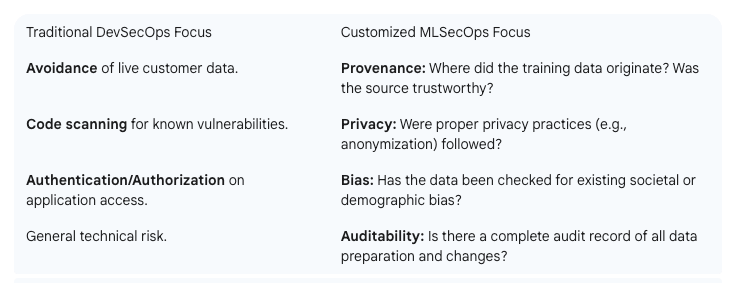
Creating effective, AI-aware threat models requires incorporating specific threats related to the technology itself. Common categories of concern include: Technique and Processes, Accessibility, Identifiability and Linkability, Security and Safety, Ethics and Human Rights, and Compliance.
Strategic Threat Analysis
While customized models focus on technical components, strategic threat models address the business risks that span organizational units, ecosystems, or impact the target operating model.
Strategic MLSecOps threat models define and address business threats influenced by AI/ML deployment, taking into account:
- Resource Risks: Given the novelty of MLSecOps, the inability to staff and manage a critical AI/ML launch (a resource-related risk) represents a significant threat to the project’s success.
- Legal and Regulatory Risks: What sectoral regulations apply (e.g., healthcare, finance)?
- Business Consequence: What is the financial and reputational impact if the AI fails to complete a core customer transaction?
Reviewing both strategic and technical threats ensures that deployed AI/ML solutions are robustly secured and aligned with overarching business objectives.
Ensuring Adversarial Robustness and Secure Deployment
Threat modeling provides the inputs for creating test plans and strategies to verify that AI/ML systems are robust and resilient against intentional and unintentional failures.
Adversarial Training and Robustness
Intentional failures, known as adversarial attacks, occur when an attacker exploits a system vulnerability. An evasion attack, for example, involves slightly modifying the input of a trained model to cause misclassification (e.g., manipulating a stop sign image to be interpreted as a yield sign).
Adversarial training is the key defense mechanism. This technique involves emulating real-world malicious activity within a sandboxed environment to observe system performance under attack.
- Perturbation Techniques: Trainers introduce controlled perturbations (noise) to the training data. For instance, changing a few pixels in an image can shift the classification outcome. By integrating these adversarial samples into the training data, engineers increase the model’s robustness and accuracy even when facing malicious inputs.
Investing in adversarial training fortifies defenses, ensuring reliable AI/ML performance even under duress.
Secure Model Deployment and Continuous Monitoring
Once the model has passed rigorous testing, the final phases of the MLSecOps lifecycle are executed: Release, Deploy, Operate, and Monitor.
- Release: This is the final gate. The MLSecOps team confirms performance, validates compliance, and may apply digital signing. The ML-BOM (Machine Learning Bill of Materials) is generated, documenting all components for supply chain visibility.
- Deploy: Models become available in production with security policies enforced. Using Policy as Code (e.g., OPA), security policies can automatically manage risks — for instance, removing all instances of a model from production if it is flagged as insecure.
- Operate: Models are protected via controls like rate limiting to manage requests and prevent DDoS attacks. Access controls and segmentation are reviewed and refined based on operational data.
- Monitor: Models are dynamic and can experience drift or decay — a gradual loss of accuracy over time. Continuous monitoring detects this degradation, providing valuable insights for retraining or adjustment. This monitoring closes the MLSecOps loop, feeding real-world data back into the planning phase to continuously improve the security posture.
By strategically applying MLSecOps principles throughout the AI lifecycle, organizations can ensure the creation of secure, compliant, and efficient AI/ML applications, effectively managing the unique risks associated with this transformative technology.
References and Further Reading
For those looking to dive deeper into the frameworks and tools discussed, the following resources provide detailed guidance for implementing a robust MLSecOps program:
**NIST AI Risk Management Framework (AI RMF 1.0) —**The core framework detailing the Map, Measure, Manage, and Govern functions for deploying trustworthy and responsible AI systems.
Download the NIST AI RMF 1.0 (PDF)
NIST AI RMF Playbook
Companion resource to the RMF, offering actionable advice and constructive guidance for putting the framework’s concepts into practice.
Access the NIST AI RMF Playbook
Microsoft: Threat Modeling AI/ML Systems and Dependencies
A comprehensive article detailing how to approach threat modeling specifically for AI and ML components, including data, model, and infrastructure risks.
OWASP Top 10 for Large Language Model Applications (LLMs)
A project by the Open Web Application Security Project (OWASP) detailing the most critical security vulnerabilities unique to LLM-based applications.
PLOT4ai: Quick Assessment Tool (Online)
An online resource that offers a quick assessment feature for users to conduct threat models focusing on ML-specific lifecycle phases and relevant categories.
Explore PLOT4ai Threat Assessment
This article was originally published at https://medium.com/@aradsouza/applying-mlsecops-to-secure-the-ai-lifecycle-be6e0acf9679